More about me
tldr: I want the future to be bright and I will work very hard to do my part in ensuring it is. I love this world and everything in it. And I am both incredibly grateful and excited to be a young person in this moment.
I was born in New York City, grew up in Cali, Colombia, and attended most of middle and high school in Boston. I am now back in NYC studying Philosophy and AI at Columbia.
My favorite music genre is ambient/experimental electronic, and if that's of interest, do reach out so that I can share the best playlist I've ever curated. My favorite TV show of all time is Lost, and my favorite comic series is The Adventures of Tintin.
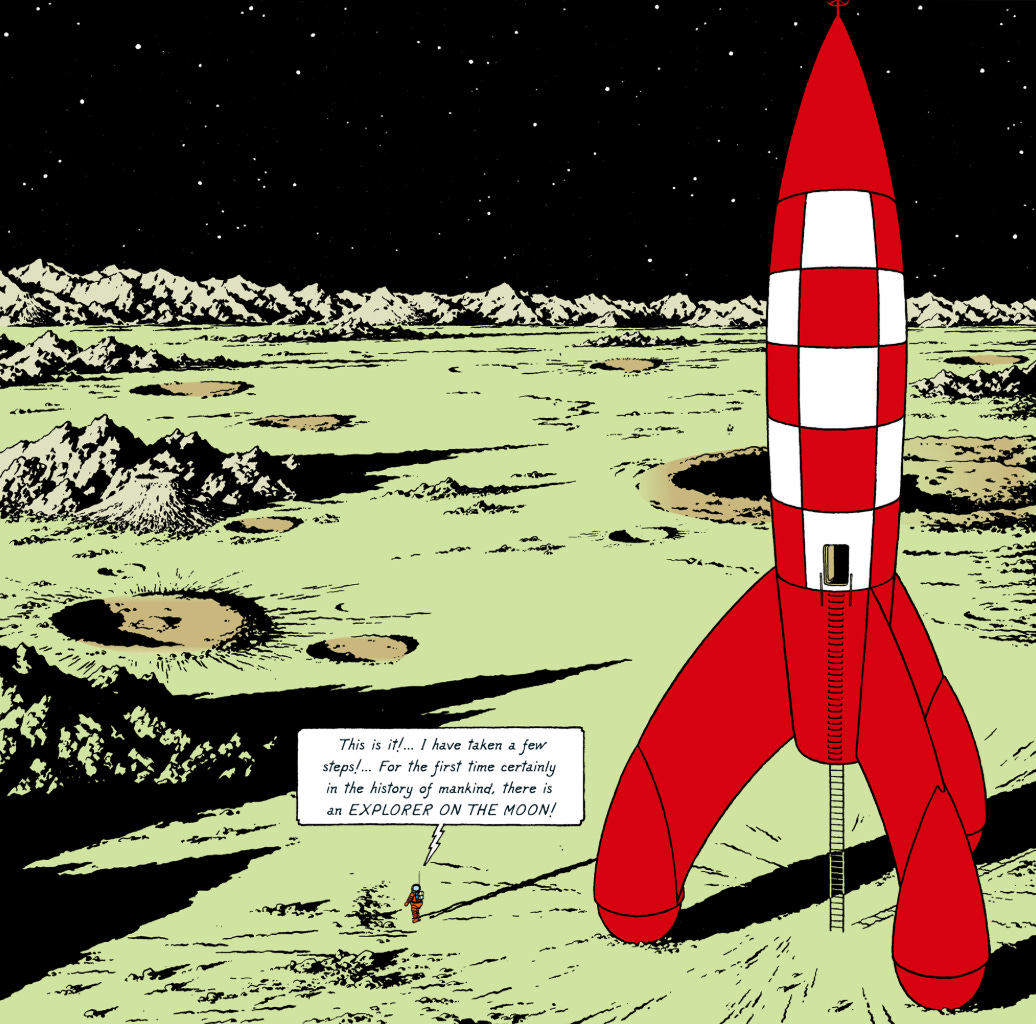
Tintin says "For the first time certainly in the history of mankind, there is an explorer on the Moon!" Who would have guessed, reading the story in 1954, the words of Neil Armstrong 15 years later: "That's one small step for (a) man, one giant leap for mankind."?
Lastly, my favorite childhood pastime was building Legos.
Philosophy major?
Yes! I have known that I wanted to study philosophy since my sophomore year of high school. If you had asked me a few years ago why I loved this discipline, I would have said that it was because I saw it as the practice of making strong arguments and arriving at logically sound conclusions. I found that (shockingly) thrilling. That is still true, but I no longer think it is what is distinctive about philosophy, because every discipline aims to make strong and defensible arguments about the world it exists in.
What I have grown to enjoy most about philosophy is the kind of "inquisitive fascination" with the world that the field has cultivated within me, as well as a love of, or at the very least, comfortability, with ambiguity, the unknown, and being pulled so far into confusion and disorientation that I am forced to rebuild my assumptions from the ground up.
Given this, you might not be surprised to learn that 1) my favorite field within philosophy is metaphysics, and 2) one of my favorite ideas within this comes from Heidegger's belief that the statement "Why is there something rather than nothing?" is the most fundamental question there is. And while Leibniz, who originally posited this question in the early 18th century, will answer it with an impassioned defense for believing in the existence of God - don't ask me for my opinions on this (or do… you'll be surprised), I much prefer the Heideggerian instinct to sit with our facticity (our "Geworfenheit") into a world we didn't choose rather than demand a rational ground for why anything is here at all. I believe it was the analytic tradition - Anscombe especially - that gave us the term "brute fact", and Wittgenstein who wrote about "the mystical". I enjoy this point of view as well.
Metaphysics (PHIL3601UN) also happens to be the best class I have taken thus far at Columbia. I am lucky enough to have studied under the brilliant Achille Varzi. He, aside from being an "expert on holes" that was called upon by CNN to make sense of 2000 Florida presidential election recount, possesses the most unique ability to make you feel every emotion under the sun in the course of a 75-minute lecture. A force of nature in every regard.
Unlike with philosophy, I only decided to study CS and AI very recently. This was for two primary reasons. The first reason was that Boolean algebra turned out to be so similar to propositional logic, a part of classical logic that sits within symbolic logic in philosophy. Thrilling! The second reason was that I arrived at the conclusion that all frontier tech was inherently ideological. This conclusion is very apparent in the founding story of Palantir, for example, which was Hegelian in nature. Also, lest you forget, Peter Thiel was a philosophy major who specialized in René Girard's mimetic theory, and Alex Karp has a PhD in social theory from Goethe University Frankfurt, the home of the Frankfurt School. Though perhaps most obvious in the case of Palantir, all frontier and cutting-edge tech proposes a vision for the world it thinks ought to exist. This is of course a reflection of the founder's own ideology, whether they are aware of it or not. As I touched on earlier, if philosophy makes you good at anything, it is breaking down arguments. And it is not a large logical jump to consider a pitch deck an argument. You should understand the ideology behind what you are investing in, or joining to help build, and there is both a moral and economic reason to do so.
More about my beliefs
I think that the most interesting thing about a person is the convictions that they are willing to defend, or better put, whatever stake they put in the ground that required effort to arrive at. The qualities I care most about in people are:
- A charitable understanding of others (which more simply might be called "empathy").
- Curiosity about the world around us and the ways in which it functions or could be better. And, arguably more importantly, the willingness to actually act on that curiosity. If something strikes you as interesting or confusing, chase it down, fully.
- The humility to recognize that the more seriously you try to know something, the less certain you become (and how exciting that is, as opposed to, say, nihilism-inducing).
- Being scrappy, which, in my view is an instinct to keep building even (especially) when a pre-built plan stops cooperating. Have grit!
I am, above all, a (cautious) techno-optimist. This conviction stems from my belief that progress, and, more specifically, the evolution of technology, is contingent, as it requires decisions, resources, and collaboration to be realized. I've come to understand technology not as something that evolves independent of us, but as something inextricably human throughout its entire value chain, from its conception to the ways it is built, maintained, and eventually repurposed by people. That framing matters a lot, I think, because if technology is a human project rather than an autonomous upward slope, then questions about "what it might do" are more so questions about what we choose to build and take responsibility for.
At the same time, technological change is fundamentally a cumulative endeavor. Each new system is built (and dependent) on layers of prior invention, infrastructure, and social adaptation. Airplanes, laptops, and agentic software are not standalone breakthroughs so much as they are inheritances of decades of prior research. The agricultural revolution enabled surplus and, eventually, the specialization of labor; the mass adoption of automobiles made the existence suburbs viable and reorganized daily life around mobility. Innovation compounds across centuries, which both expands the frontier of what is possible and, at the same time, deepens the responsibility embedded in each decision. Recognizing that "building something" is never starting from scratch, but instead intervening in a long, accelerating chain of human choices, is another aspect of innovation that I find deeply compelling.
Back to why I am an optimist, well, the world has gotten better over time (objectively) because real people worked (mostly on better technologies) to make it so, and I find that fact incredibly motivating. The longer version of that reasoning is here.
Venture turned out to be a place where that motivation/optimism has somewhere useful to go, which I didn't fully expect, and neither did I expect how philosophically saturated this world would be. The most recurrent conversations are drawn from a fairly specific canon (EA, longtermism, rationalism, techno-optimism). I don't agree with a lot of the conclusions being put forth, and frankly, a lot of it is just bad philosophy, but the fact that these conversations exist at all, that people in this industry argue seriously about ideas and their consequences, is exciting.
Other things
Lastly, perhaps the two most guiding principles I've developed over the last few years. The first is a deep sense of gratitude. I feel incredibly lucky to be alive right now, to have been born into what I consider the single most exciting period of technological progress in human history, a moment where the distance between having an idea and building something real has never been shorter. The second follows directly from the first, which is the belief that everyone can be a technologist. This era of innovation has given you and me an unprecedented opportunity to create, and I think that comes with a responsibility. I would not go as far as to say that it is a moral failure to step away from technology, but I do think there is a real duty, especially for those of us who care about the future, to participate in shaping the kind of world we want to inhabit. To me, that means you cannot ignore the technological innovations of our time, as they are deeply entangled with the kind of future we will live in.




I can be reached through my email, vla2117@columbia.edu, or on LinkedIn messages. You can also find me on GitHub and X.