
Digital Darwinism in Ukraine's Drone Technology
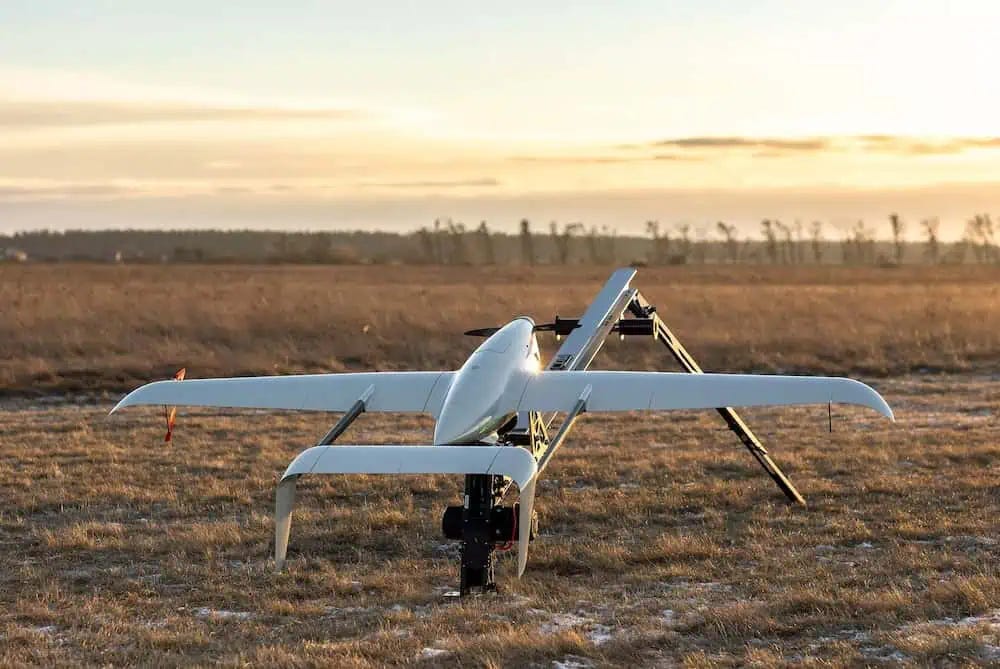
Skyeton’s Raybird-3 / ACS-3
Three years ago, in an effort to become more cosmopolitan — and to hold my own in my parents’ geopolitical dinner table conversations — I traded my morning Spotify playlists for the NYTimes The Headlines podcast. I have tuned in faithfully every weekday since, and last week brought a particularly arresting discussion: Ukraine has implemented a gamified drone attack system that awards operators points for successful missions — eight points for wounding a Russian soldier, twelve for a kill, forty for destroying a tank — which soldiers then redeem for weapons and system upgrades. (Russia, for context, rewards its operators with cash prizes, which says something, though I’m not sure what.) The gamified model has proven remarkably effective: with careful calibration of the point values per mission, Ukraine’s kill count doubled in a single month.
The decision to gamify drones specifically is not incidental. Drones are arguably Ukraine’s most consequential weapon right now, accounting for roughly two-thirds of battlefield deaths. Their effectiveness has been so total that Ukraine has deployed them in the millions, transforming a war historically defined by tanks and artillery into something else entirely — an accelerated testing ground for some of the most lethal technologies on the planet.
What I find most interesting about this testing ground is who is actually running it. The dominant players are not the defense giants that anchor Western indices — your Raytheons, Lockheed Martins, Northrop Grummans — but a sprawling, distributed network of small Ukrainian companies, volunteer engineers, and civilian hobbyists competing to design the next breakthrough. The battlefield has become a laboratory for rapid prototyping and real-time feedback, and the whole structure operates with a logic that more closely resembles a startup accelerator than a conventional defense procurement system — with the war itself functioning as the accelerator. Thousands of drone models are tested and modified in a matter of weeks, compared to what would traditionally take years, and designs that fail are discarded immediately. This loop of iteration, funded by private donors, state programs, and international crowdfunding, has produced an innovation velocity I have not seen replicated in any traditional defense contractor. It is, in the most literal sense, Digital Darwinism: designs survive or perish based entirely on real-world performance, and the fittest rise to dominance on the battlefield. The difference from any commercial analogue is that the market feedback here is measured not in revenue, but in lives.
My personal favorites among the startups operating in this ecosystem: Skyeton, Terminal Autonomy, and Aerorozvidka. Skyeton produces the Raybird long-range drone, built for reconnaissance and artillery targeting, capable of flying up to 2,500 kilometers with modular payloads. Terminal Autonomy, a spinoff from university researchers, works primarily on AI-driven navigation — drones designed to complete missions even when GPS and communications are jammed. And Aerorozvidka is perhaps the most emblematic story of all: a volunteer collective that began as a group of tech enthusiasts and has since become a critical component of Ukraine’s front-line operations. In this ecosystem, innovation moves faster than in any Silicon Valley incubator — it has to. Designs are tested in the field, feedback comes directly from soldiers, and updates ship in days.
I cannot publish this in good faith without noting that it is easy, from a distance, to focus on the technology and lose sight of what is underneath it. Beneath all this innovation is something harder to quantify and equally deserving of attention: the fact that every one of these startups, collectives, and engineers is building under conditions of existential pressure, driven by survival and love of country. In Ukraine’s drone revolution, ingenuity and endurance are not separable; one is the condition for the other. The fittest designs rise not because of clever branding or favorable market timing, but because of the creativity and determination of the people who built them under circumstances most of us will never come close to understanding. It is, in equal measure, a story about technological innovation and about what human beings are capable of when the stakes are absolute.