Mapping the Future: How NVIDIA's Earth-2 Predicts Climate
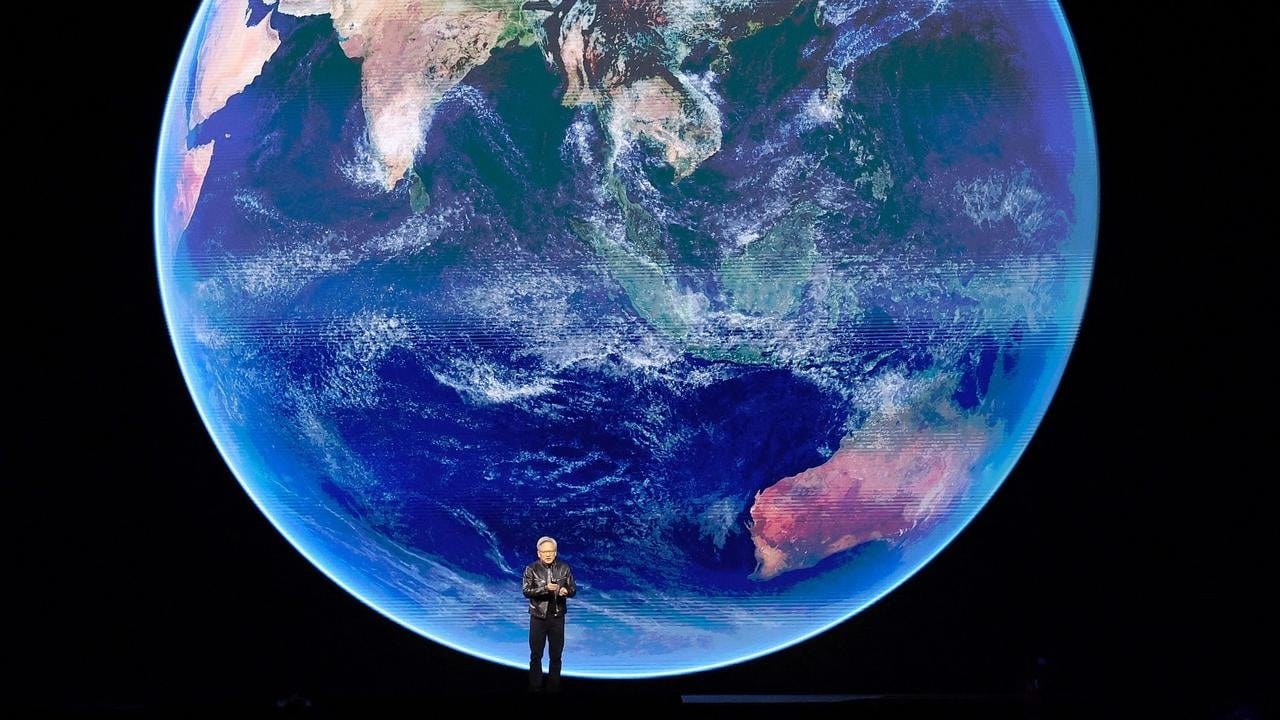
Nvidia CEO Jensen Huang announcing the Earth-2 Initiative in November 2021.
Dr. Karthik Kashinath is a principal engineer and scientist in HPC+AI in Developer Technologies at Nvidia. He co-leads the Nvidia Earth-2 Initiative, a digital model of the earth that combines AI, physical simulations and computer graphics technologies to simulate and visualize weather and climate predictions at a global scale. His work uses machine learning to emulate high-resolution weather and climate data, build digital twins, and provide actionable climate information. Dr. Karthik Kashinath uses machine learning to accelerate scientific discovery in the complex chaotic systems of turbulence, weather, and climate science. He received his bachelor’s degree from the Indian Institute of Technology Madras, his master’s from Stanford University, and his Ph.D. from the University of Cambridge. This interview was conducted as part of Gadfly Magazine’s interviews series. Find the original article here.
VERONICA**: Could you give us some insight on what you’re working on these days related to the Earth-2 initiative?**
Dr. Karthik Kashinath: Let me start with what we’re working on these days. This project was launched about three years ago in November 2021 by our CEO, Jensen Huang. He saw an opportunity for AI to have an impact on how we can better address climate change—that includes trying to better predict what might happen with climate change, extreme weather, impacts on agriculture, energy, rainfall, on a whole range of different sectors that impact humans, our societies, our industries, our ecosystems, all of it. That was the opportunity that he saw, and he wanted to make a big push on using technology and AI in particular, to help address this grand challenge that we face. There are many ways in which we could do that, and we’ve started to explore over the last few years some of the most challenging ways in which we could make a big impact.
Predicting climate change is, as you can imagine, incredibly challenging. It involves trying to predict what the physical earth system does. What are the oceans doing? What’s the atmosphere doing? But it also includes how humans are interacting with this system. Obviously, humans are responsible for anthropogenic climate change. And by that I mean we’re pumping in a lot of carbon dioxide and greenhouse gasses into the atmosphere, and we know that’s responsible for global warming and climate change. How we use our land impacts climate change, the ways in which we interact with forests, with ecosystems, with plants, with animals, with water resources, all of that impacts climate change as well. It involves humans and our societies, our industries, our emissions, all of that coupled together. Trying to predict what might happen five years from now, or ten years from now, involves trying to understand how all these different systems interact with each other, and that’s a problem that’s well suited for AI. AI is incredibly powerful at learning from very complex data sets, and being able to see patterns in that data and use those patterns to come up with forecasts or predictions of what might happen. AI is a tool that can be used to digest the vast amounts of data that we have about the Earth system and then synthesize that into patterns of change and patterns of evolution and use those patterns to predict what would happen.
This is typically done using numerical simulations. We scientists have been studying Earth’s climate for a century now, and we’ve had climate models for probably about 70 years now. Climate models are typically the equations of physics that describe what’s happening in the atmosphere, in the oceans, over land, and our assumption of the emission pathways for how humans are going to emit carbon dioxide and greenhouse gasses into the atmosphere over time Then you feed all that data into these climate models, and you ask, if humans were to do this to the planet, how would the planet respond? The climate model then goes into its computational system, the supercomputer, and in response to our input of how much carbon dioxide we put in, all the different changes that we can expect to see on the planet.
This is a very slow, expensive, and time-consuming process, and it inherently requires the use of computers that are very expensive and energy hungry, and therefore are perhaps not the best tool for us to be predicting climate change. AI is very well suited for this problem, because there are vast amounts of climate data available from the last century or so, and we also have lots of physical equations that describe what’s happening in the Earth system. What we’re doing right now in this Earth-2 project at Nvidia, is trying to adapt the best AI tools that we have to address climate change. We are providing the best data that we have on climate change into these AI models, and teaching them and training them how to predict what will happen in the future.
We’re finding that AI models are quite good at predicting the probability that we might have more wildfires in California or in Oregon or elsewhere in the future. That’s one example, and another is extreme hurricanes. Obviously, hurricanes are a big challenge for us. We’ve seen, even in the last couple of months, the kind of impacts from these big hurricanes that battle through the Gulf of Mexico, the southern US, and occasionally the eastern seaboard as well. These hurricanes are getting more intense and more frequent because of climate change, and that’s something that is not that easy to predict. We’re finding that AI models are incredibly powerful at learning how to predict hurricanes, and predict the trajectories that they would take. In fact, at this point, AI models are even better than some of the numerical models, the scientific models that we’ve used for the last century for these problems. That’s another example where AI is really making an impact. That’s two examples of the sorts of things we’re doing with Earth-2 right now.
Intuitively, humans seem to be less easily modeled than other natural forces, which we think of in very deterministic terms. Factors like policy and technological progress seem like massive complications for the model. How does Earth-2 account for these unpredictable elements?
Like I said, I think there are an infinite number of ways in which humans interact with the earth. We’re changing the atmosphere by emitting a range of greenhouse gasses and lots of pollution and other particles. We’re putting a ton of material into the ground in terms of landfill. We’re changing the forests and the ways in which we use land. We’re changing the ecosystems of the Earth, but we’re also changing the oceans. We’re interacting with the oceans in complicated ways, including, unfortunately, polluting them. It’s hard to incorporate every single dimension, every single aspect in which humans interact with the planet explicitly, but we try to categorize these into major categories of interaction.
One example is how we account for the emissions of greenhouse gasses into these models. We quantify how many gigatons of carbon dioxide we are putting into the atmosphere. That’s one metric that goes into these models. Another is land use. The way in which we use our land has a very big impact on climate change. Are we building bigger cities? Are these cities made of concrete and steel? How is that different from having forests or grasslands or mountains? We have ways to feed in information about the land surface and how that is impacting the planet with the ocean.
In Earth-2, we haven’t gone into a high degree of sophistication with the ocean just yet. But I imagine that in the future, we’re going to have more specific, more explicit characterizations of how humans are interacting with the ocean as well. I think one thing to keep in mind is that climate change, at least at first order, can be distilled into the amount of CO2 that we’re putting into the atmosphere. That’s by far the biggest lever that we have on climate change. If you look at, for example, David Attenborough’s inspirational speech that he gave at COP 28 last year, you’ll see that he talks about all these different nations that are trying to make a bet on climate change and address it in different ways. He gives this really powerful anecdote of how the one number that really is the bottom line on climate change is the amount of CO2 in the atmosphere. So if you think the best way in which we can try to help address climate change, the best way for us, as humans, is to reduce the amount of carbon dioxide that we put into the atmosphere. That’s the most important factor, and that’s accounted for in our models. Of course, there are secondary factors. Those include how we use the land, how we impact sea ice, how we impact the oceans…and some of those are also incorporated.
I’ve seen Earth-2 be called a digital twin of the earth that works on a kilometer-by-kilometer scale. How do you know if you’re making the right simplifications in this model?
This gets down to how scientists model the natural world. We’ve done this for centuries. Isaac Newton models how gravity behaves, and it works incredibly well. And it’s worked well for centuries. Scientists came along in the early 20th century and revisited Newton’s laws and came up with more sophisticated ways of describing how the universe works, and that’s quantum mechanics. Some of the assumptions that Newton made were questioned, and then we came up with better ways of describing what’s happening in the universe. Similarly with the ways in which we model the Earth system, we make these simplifying assumptions, but then we question those assumptions by running different experiments. For example, with the oceans, we have a simplistic way in which we describe the oceans in these models, but we can adjust our assumptions because they’re basically experiments that you can run on a computer.
You can change these assumptions—you could say, I’m assuming that the ocean can be characterized by a handful of different metrics, like temperature, salinity and depth. You have this relatively simple set of metrics that describes what the ocean is like in the model, but you can change that description, and you could have a different set of metrics, and you could change one metric at a time and see how important it is in the model. That gives you a sense of how you might remodel things to see how accurate your model is. The second way is to compare it to what we’ve seen in the past. We can run experiments of the past. We could say, let’s take the same model that we’ve built for the earth in 2024, but let’s run an experiment where we try to look at what happened to the earth in the year 2000 or in 1950. You can go back in time for what the model predicts for, say, the year 2001. Now, the great thing is, because 2001 happened already, we know what the answer is. So we know what the data says, and we can go back and see if the model predicts what we saw actually happened. You can test the accuracy of the model by looking at historical data and looking at whether the model was able to predict something about the past that we already know. That’s one way of confirming, or at least building confidence in, the assumptions that you bake into the model.
Let’s say that hypothetically, the model is wrong, and a policy-maker or government actor makes a decision based on that and it results in an avoidable disaster? It seems like the policy and legal framework present hasn’t necessarily caught up to how fast the tech industry is moving. So who is liable for this destruction? Is there an ethical framework holding the model responsible?
That’s a great question, and a really complicated one. I would say this question is not fully resolved yet, to your point about how quickly these things are changing. We haven’t caught up to exactly how we address the implications or the impacts of the use of this technology. But that said, I’ll go back to the example of what we’ve been doing in the past, which is using climate models. We know that these climate models have imperfections, and they’re not 100% accurate or deterministic. They can give you different results depending on how you incorporate different sources of uncertainty into the model. You have a range of possibilities, a range of futures, and you have the most likely future that we expect. But you also have the worst case scenario and the best case scenario. You don’t get one answer, you get a range of answers. The way in which I would say we’re trying to address the impact of AI and the use of AI in this space is to also incorporate these uncertainties into the AI. We’re presenting not just one possible prediction of the AI, but we’re trying to see the range of possibilities that you can have. I think that’s important, because as a policy maker, you need to know not just one outcome, but the range of possible outcomes.
In coming to your second part of this question about liability, that’s a challenging one, because of the various sources of uncertainty that go into the AI. It’s a model that’s being developed by engineers and scientists, using data that we’ve built up in an archive of data over a century. As with every model, it assumes simplifications about the earth. The stakeholders involved are the private sector, because the private sector is developing these models, the public sector, because governments contribute the data into these models, and the global scientific community, because we’re building on the vast amount of knowledge that exists in the literature. It’s really not just a single entity, like one company or one person or one organization that contributes to the development of these models. If we were to make a policy based on the predictions of the model, but it turns out that the model was incorrect, there isn’t one person you can point a finger at and say, it’s because of that entity that this whole thing went wrong. Policymakers are trying to use this information instead to say, here’s something that the model predicts that we can rely on, but we also know that the model is giving us a range of uncertainty. We have to be aware that this answer could be wrong, and there’s a range of possible ways in which it could go wrong. I think they’re trying to factor the liabilities associated with that prediction into insurance and various other types of financial instruments. I might take a step back and ask the philosophical question of, should we act and take action based on an imperfect answer, or should we be afraid and wait for the perfect answer that might never happen? We might never have a perfect answer because it’s such a complicated problem. The reason I say wait and bring that time dimension into this is because it’s a very urgent problem. The consequences of not acting because we don’t have a perfect answer are probably worse than acting on an imperfect one.
Have we seen this sort of urgent need for collaboration between the private sector, public sector, and scientific community before? I am reminded of the rush to create a COVID-19 vaccine during the pandemic.
I think the COVID-19 pandemic is a really good example of how humans have great potential to respond under duress and under great amounts of stress and urgency. In some ways, it’s also reassuring and inspiring that we can respond to such global challenges under tight deadlines and under severe stress. The COVID-19 pandemic took hundreds of thousands of lives and impacted every corner of the planet, and we responded with insufficient information and incorrect data, without perfect answers to every question. We were able to bring things to a point where we felt like we had control over the pandemic, and we were able to regulate things. It’s very encouraging that within a short span of about a year or so, we could respond to such a global challenge in a very effective way. I think we have lots of lessons to learn about how we responded globally to the pandemic. What could we learn from that that could be useful in how we respond to climate change?
There was no shortage of misinformation during the COVID-19 pandemic. Is there anything you would take away from the public’s response to the pandemic that would inform how the Earth-2 initiative is presented to the greater public?
How do we get the public engaged in Earth-2? Humans build confidence in these technologies and these systems when they can interact with them and have favorable interactions. Otherwise, it becomes a source of fear and something that we get worried about because we don’t know how it works. We don’t know what’s under the hood, and we’re not all capable or equipped to understand the inner workings of these things because that’s just not our expertise. It’s very important that we build trust over time with how these systems operate, and how the public views these technologies and systems so that we can start to use them. The way we’re trying to do that right now is by having systems that humans can interact with. One of the goals of Earth-2 is to make it an interactive digital twin, by which I mean that, you could go in, for example, and say, I want to see what the earth is going to do if I have this particular scenario. I want to see what’s going to happen in New York City and in this neighborhood of New York City, and what’s going to happen to Columbia University? Is it going to be flooded if there was a big hurricane that came along? Being able to ask these questions to the model, these what-if questions, and get answers, and visualize those answers, to be able to see it on a globe, to be able to zoom into specific parts of the planet, maybe the neighborhood that you live in, or the neighborhood that you were raised in, in some other part of the country, that’s the way in which we’re hoping to be able to get people to engage with with the system. That’s one way in which we get people to build confidence.
Of course, it’s not possible for everyone to be able to get into the mechanics of how this model works, and what data goes into it. That’s the scientists that are evaluating the model. We write up everything that we do and try to publish it in scientific journals, which means that it gets peer reviewed, so there’s other experts in the fields that question the ways in which we’re developing the model, the kinds of data that we’re using, the methods that we’re using. So it’s all being verified and validated by lots of experts, and that’s how the model itself is. We’re building confidence through the model by having it verified and validated by experts outside Nvidia.
Another factor is to get companies and governments, the public and private sector, to use the digital twin, to use the model. One example is that we’re working with the US government, with the Department of Energy, with the National Oceanic and Atmospheric Administration, NOAA, with the National Weather Service, and they are using Earth-2 to make predictions for the weather, to make predictions for the climate, to try to predict wildfires or hurricanes, or use it for wind energy or solar power. There are lots of other public and private sector entities that are using Earth-2, and as they use it for their businesses and for their work. They build confidence in it, they write testimonials and they say, we’ve used Earth-2, and it’s really good at predicting hurricanes. Or we’ve used Earth-2, and we’ve developed this wind power plant that is now producing X megawatts of power. And we really like the model, because it does a really great job of telling us when there’s going to be high wind or low wind. When people give feedback like Earth-2 is really good at ABC and Earth-2 is not that great at XYZ, then we get a better sense of where it can be trusted. I think a really good parallel is Chat GPT. By using chat GPT, all of us have a sense of what it is good at and what it is not good at. For myself, I think Chat GPT is a really good tool if I want to learn something quickly about something that I don’t know, or if I want to plan a trip. But I tend not to use Chat GPT to learn about the latest advances in a particular scientific discipline, because I don’t think it has the expertise that a nature or science paper would have. I’d rather go read about a scientific breakthrough in a research article like a journal like Nature or Science, than try to ask Chat GPT to teach me about it. There are different pros and cons for how you might use a tool, and that’s the same sort of thing that I think we could develop with Earth-2 to do with the public.
Fighting climate change is sometimes discussed as a sum of small actions. This seems especially true in policy efforts to limit individuals’ daily carbon footprint. Earth-2 seems to avoid this level of detail. How do you see Earth-2 informing views on sustainability at the individual level?
There’s definitely some education that needs to happen across the board on the relationships between individual climate action and these higher level metrics that go into the biggest influences on climate change. That’s a gap that Earth-2 still currently does not address, and it’s not intended to address it. The complexity of every single individual’s climate action, 8 billion people, inputting all of that data into a model, and having a model be able to understand and synthesize that information and percolate up into the model’s mechanics is incredibly complicated and challenging. It’s not something that we have the capability to do right now, I would say. But there is room for us to understand how our individual climate action contributes to regional scale or national scale or global scale. For example, if we all as individuals start to become conscious of our carbon footprint, we can start to put in numbers that really estimate how much our carbon footprint is per year. You can imagine, if we all were able to do that, then it would add up to the carbon footprint of the United States or the globe—that’s the sort of information that we can put into a model like Earth-2. You can see the connection between individual climate action around something like carbon footprint, how that would feed into the model at a higher level. Something like composting, for example, that’s a lot more complicated. First of all, right now our descriptions of the land and how the land impacts the climate are relatively simplistic. In these models, we’ve got high level categories of this amount of square miles or thousands of square miles of forest, and this is the number of square miles of cities. The descriptions of the land are at that level of granularity. But if you want to get into really fine scale details, like how much compost is on the land, or how much landfill, or how much plastic, or the temperature of this forest, and the amount of water that’s there under the soil—that’s a different degree of granularity that currently doesn’t go into the model. At the same time, composting is very important in how it impacts the land and how it impacts the quality of the ecosystem, and that feeds back into how the ecosystems are able to capture more carbon from the atmosphere and clean up the air, and improve our air quality, etc. There is all this feedback that composting has benefits, but it’ll probably take a little while before we can figure out good ways of incorporating that degree of feedback into the model.
Do you see the future of climate science, climate change modeling and prediction as inextricably intertwined with AI?
100%. I think we’re headed in a direction where AI will be an integral part of pretty much every piece of technology that we have, especially in climate change, and climate modeling. I think we’re going to be predicting the next vaccines and the next drugs that we develop and the next medicines that we develop using AI, along with human knowledge and scientists and lab experiments. We’re going to be developing new materials, possibly materials that are able to absorb carbon dioxide from the atmosphere and help mitigate climate change using AI. AI is already making a huge impact on material science and developing new materials for batteries or for solar panels or extremely strong materials that are lightweight for building ships or airplanes. In my mind, there’s no doubt that AI is going to be inextricably integrated with pretty much any scientific endeavor in the future.
There seems to be a lot of anti-AI sentiment online. How do you, as an engineer of AI, respond to this?
Just to be clear, it’s not a miracle. I mean, it is sort of a miracle, but it’s also not. It’s not a silver bullet. In every regard, there are certainly risks and challenges, but I’m also confident and hopeful that we’re going to address those risks and challenges. It’s not that it’s completely free of any problems and AI is going to solve everything on the planet. That’s not the case, but I do think that we have the capacity to address the risks associated with AI, to address the challenges associated with AI. The best minds on the planet are working on it, and I’m confident that we’ll find ways to figure out how to use AI well and what to be careful about, and where we should double check things that are developed by AI or predicted by AI, what they call guard rails. Ways in which we can make sure that the AI doesn’t totally go off the rails and predict something that is berserk. I think there are definitely ways in which humans can interact with AI to make it even more useful and powerful than it is today.