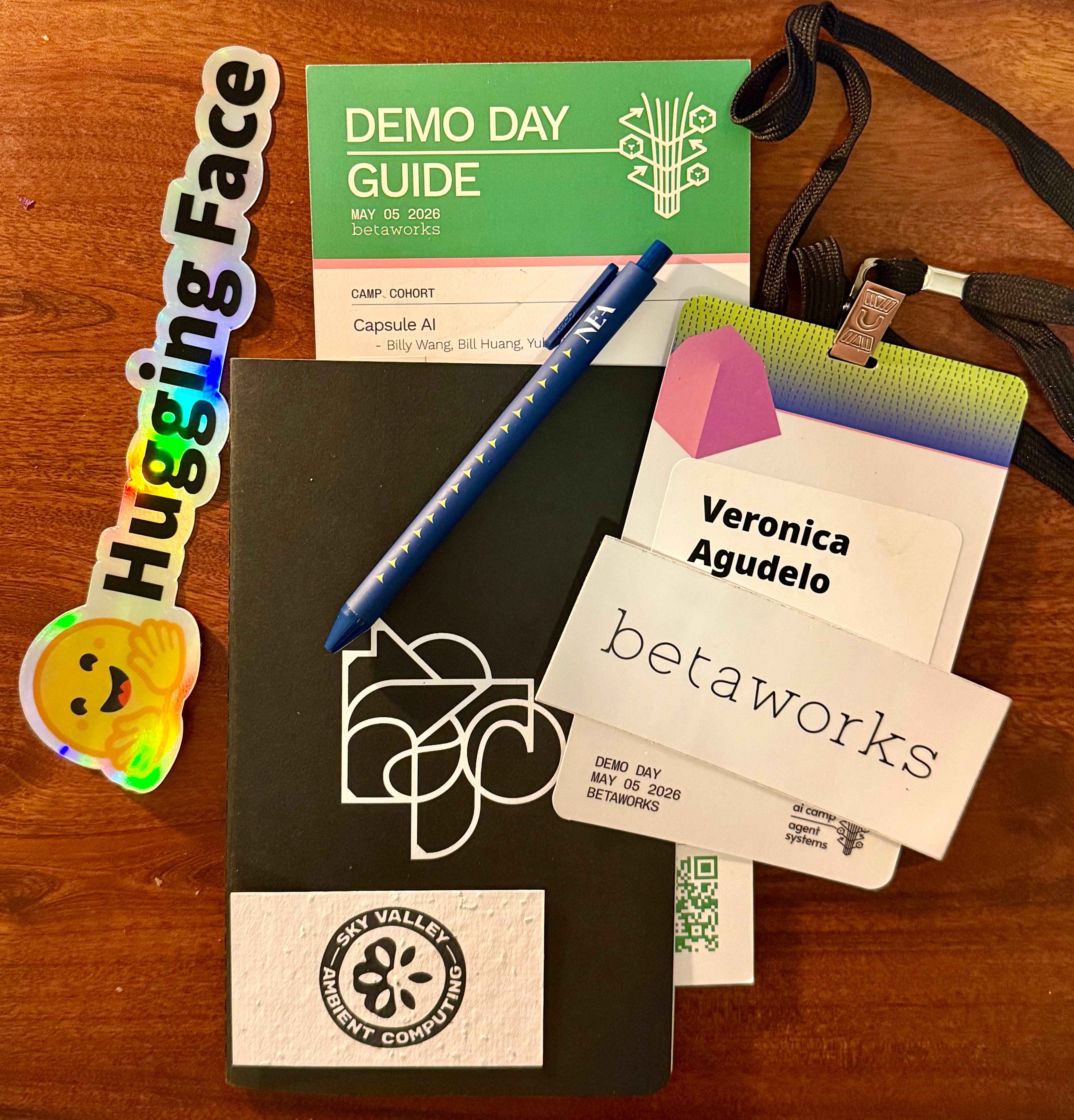
Notes on Agent Camp: Betaworks Demo Day Spring 2026
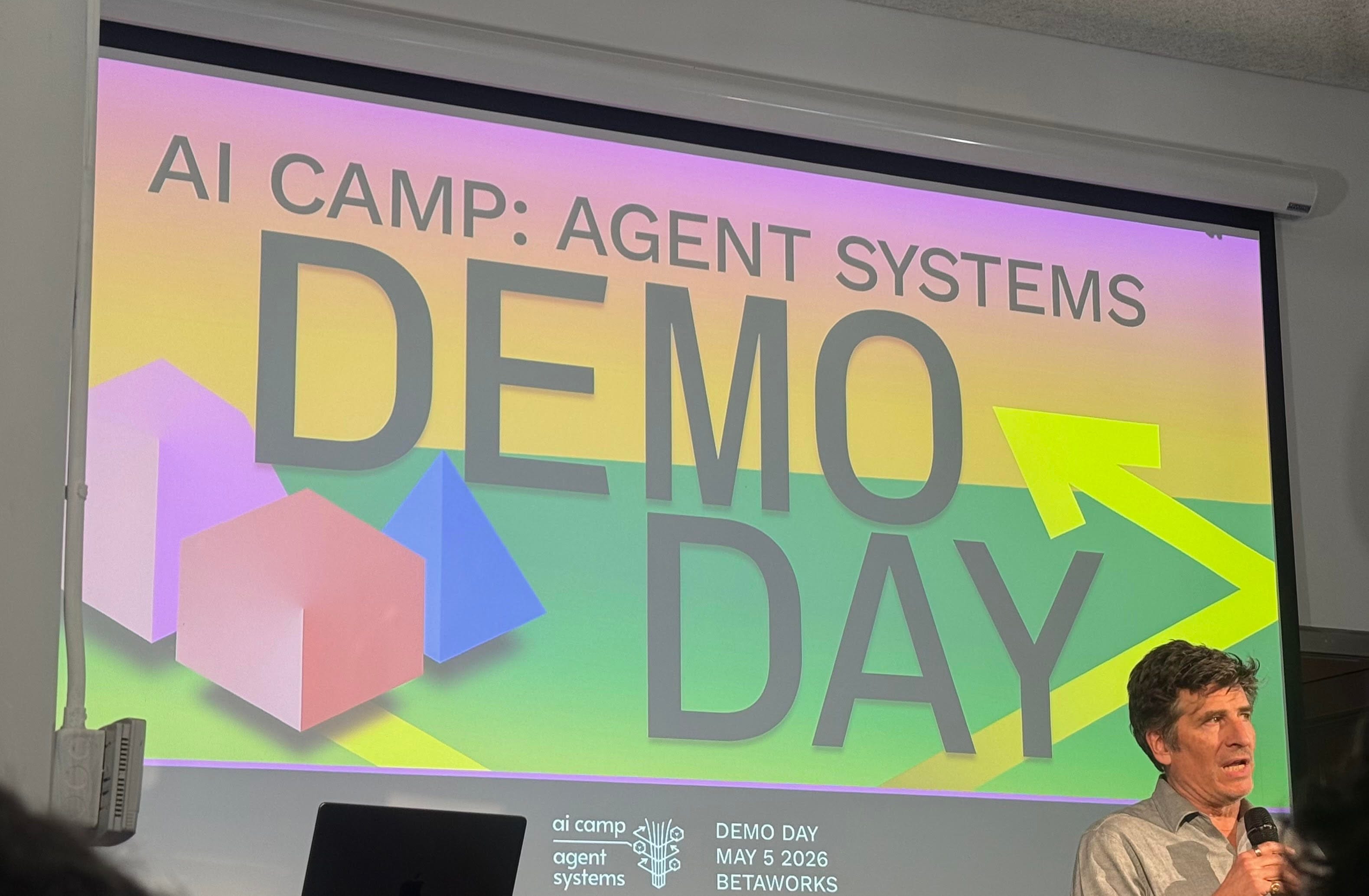
If you happen to find yourself in Union Square and walk directly west for exactly one mile, you will end up outside Betaworks. Not quite an office, more a single large room with exposed pipes and brickwork (because duh, you are in the Meatpacking District). It sits directly across the street from Aubi & Ramsa, an alcohol‑infused ice cream shop I’ve been told is fabulous. So if you make the trek I described above (and are over 21), you should probably stop for boozy ice cream on your way out.
I made that trip yesterday (sans ice cream) for Betaworks’ Camp Demo Day. This year’s theme was Agent Systems, and if you’re not fluent in Betaworks lore or the current jargon of AI, here is some helpful context:
Betaworks is a fabulous combination of a startup studio and pre-seed/seed‑stage firm that backs product‑driven companies, especially in AI and consumer software. Alongside the fund, they run “Camp,” a cohort‑based program where 8-12 teams come to New York for twelve weeks to build, get help on product and GTM, and then present at Demo Day. Past camps have incubated companies like Hugging Face and Granola.
This year’s camp is about Agent Systems. Betaworks defines an agent system as a company‑scale system in which agentic AI components perceive context, make plans, and execute end‑to‑end work with minimal human orchestration. In other words, not “AI as another layer in a human-led workflow” but products that assume from first principles that autonomous, goal‑seeking software is the main actor in the business.
The official Betaworks post breaks this down into a few properties:
- Perception and memory: systems that synthesize context from many sources and remember across interactions.
- Autonomous planning: systems that can form multi‑step strategies toward abstract goals.
- End‑to‑end execution: agents that complete whole workflows as opposed to just the middle 20%.
- Adaptability and self‑evaluation: systems that can critique their own output and adjust course.
So yesterday, in that brick‑and‑pipe room in Meatpacking, a handful of founders tried to answer a rather complicated question: if software can increasingly perceive, remember, and act on our behalf, what should a company built around that reality look like?
The first company to pitch us (us being a room of exited founders, pre‑seed/seed investors, and tech‑of‑the‑future enthusiasts, and me) described Camp as “a microcosm of frontier technologies,” which I think is right. The cohort companies were wacky and out‑there, and their founders were too!
Please find below a few of my takeaways: big themes I noticed, the companies that stood out to me and why, and some questions I left with and want to keep tugging on.
Companies I loved the most + why
I should preface this by saying that every single company that presented (10 total) was built on a brilliant, surprising, and creative premise. Most I agreed with or at least found compelling in some way, and all were a treat to see. I have a lot of respect for these founders and am excited to see where they go. That said, a few companies stood out to me in particular, all for different reasons.
Sky Valley’s founder, Noam Tenne, opened with the argument that despite the wave of innovation in software development over the past few years — “vibe‑coding,” better tooling, faster iteration — people still ship like it’s 2020. Those innovations let us build faster, yes, but that’s now table stakes. The next frontier, in his view, is software that actually grows with its users.
Enter Sky Valley, a platform for developing adaptive software that learns from and makes seamless changes according to each individual user. In the demo, we saw two users of a fitness app. One cared most about tracking and seeing her cardio (time, calories burned, activity) every evening. The other logged the same water intake every morning. With Sky Valley wired into this theoretical app, the system watched the two users, learned their patterns, and then proposed individualized app updates for each. After reloading, their interfaces had reshaped themselves: User 1 now had a home page structured around her cardio, and User 2 had a dedicated button to log exactly the amount of water he drank every morning.
These are relatively simple changes, but the point is that Sky Valley observes behavior, makes appropriate, highly specific updates, and then lets those changes compound over time. In that world, you and I could be “using” the same fitness app, but it would be entirely tailored to how each of us actually moves through it, serving completely different interests.
You might reasonably wonder whether this level of personalization is necessary, or if anyone really wants it. Noam’s answer is that adaptive software makes changes that “do not feel obvious until they’re there.” A dedicated button for logging the exact amount of water you drink at the exact time you drink it sounds trivial, sure, until you realize it removes the annoying sequence of 1) logging a liquid, 2) choosing water, 3) specifying the amount, 4) noting time of day, and so on.
There is also a massive potential market here, if it works. The idea of individualized, adaptive software feels like a logical progression from where we are now. So cool!
Founded by siblings Gigi and Everett Grimes, Pai starts from the observation that there is a rather inconvenient fissure between tech culture (“move fast and break things”) and the world of CPG innovation. In CPG, you cannot actually “move fast and break things,” even though you’re expected to, because iterating on physical products means placing real‑world bets: you often have to order packaging and inventory in bulk, commit to retail or DTC tests, and then wait to see what happens in market.
In other words, you cannot just “ship 10,000 units and hope for the best,” then pivot next week if it flops. The stakes are high, the feedback loops are slow, and every decision is capital‑ and time‑intensive.
Pai’s bet is that AI‑native simulations can shrink that gap. They turn real consumer data into AI simulations (“AI twins”) that let brands quickly test questions like “Which design do Gen Z consumers prefer?” or “What actually drives purchases for this product?” before they commit to big production runs. The idea is to bring something closer to software‑style iteration into the physical world, so founders can explore many more product, packaging, and messaging variants before they place a single order.
As a quick aside, for most of the afternoon, Camp was being narrated by a very familiar demographic. Gigi, who pitched Pai, was the only woman pitching a company and also gave the clearest, most disciplined presentation. Very far from “AI guys and their toys.”
I told you guys I caught the healthcare bug… well, here we are. PillPilot starts from a bleak but accurate insight: pharmacists are not doing the job that they spent years of schoolwork and money training for. Most of their days, and the pharmacy system as a whole, are held together by phone calls, faxes, and humans re‑typing the same information into three different systems, which is wasting everyone’s time.
Their response to this is not a flashy “AI for diagnosis” or “AI doctors,” but something much more prosaic and believable — back‑office agents that run refills, insurance checks, and prior auth workflows. In the story they told on stage, an avalanche of prescriptions with incorrect insurance info becomes a test case: instead of an overworked pharmacist spending hours on the phone, PillPilot’s agents call (yes literally call, we got to hear the agent hold a full conversation with a fake doctor — see picture below) the relevant parties, reconcile mismatched data, and then write changes back to the real system.
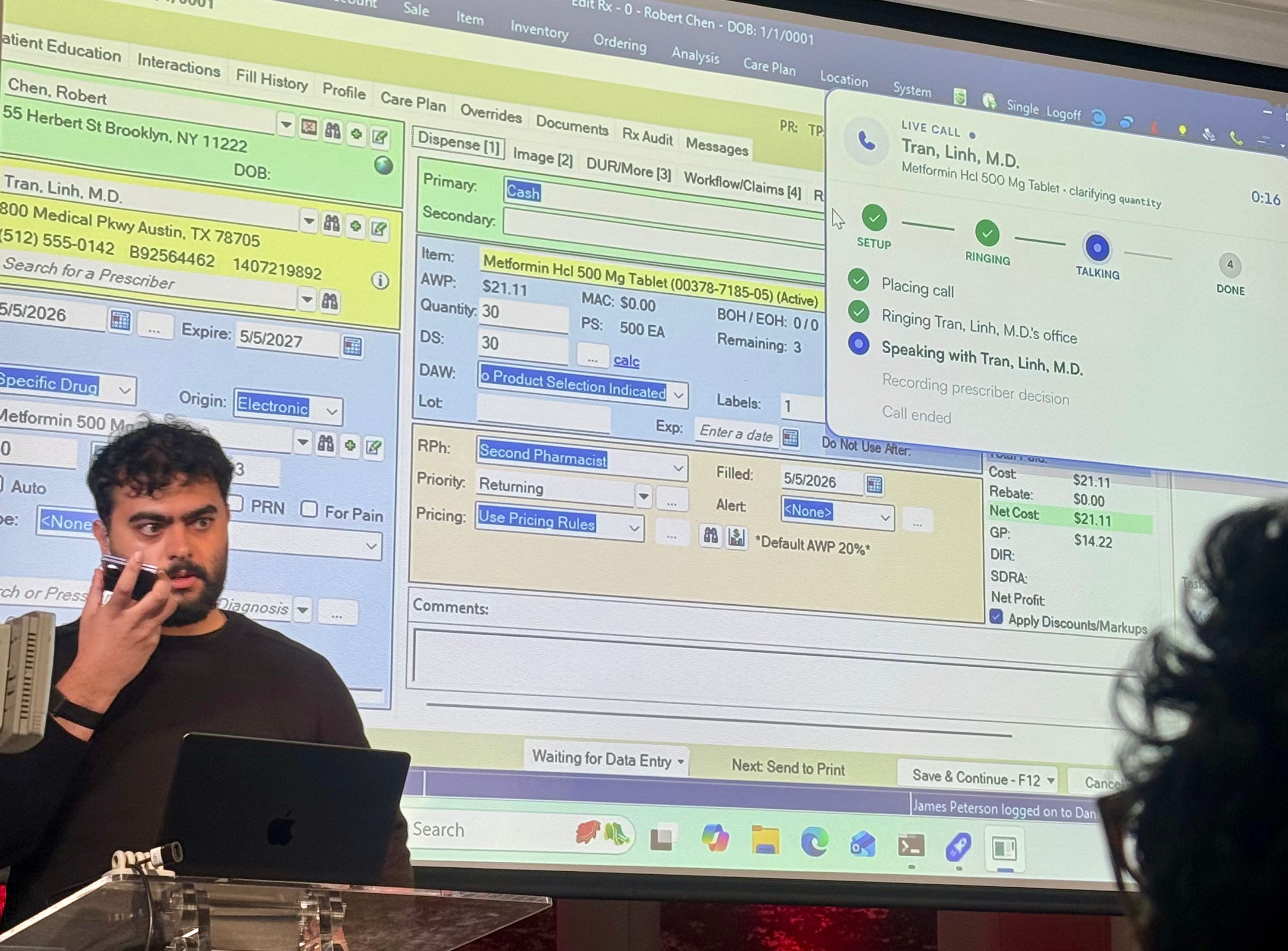
I liked this idea in particular because it is a very opinionated answer to the “where should agents live in healthcare?” question. PillPilot’s answer is that they belong deep in the plumbing and far away from clinical judgment. It is less sci‑fi than an AI doctor, but if it works at scale (which, according to their traction slides, is ramping up), this could be the type of product that changes what pharmacists do all day.
Healthcare again! I told you. Capsule wants to be the cognitive core of pharma — essentially the OS for life sciences strategy. In practice, that looks like an agentic layer that ingests everything from conference chatter and clinical trial registries to publications, SEC filings, and commercial data, then helps teams answer questions like “What is our competitor actually doing in this indication?” or “How should we allocate launch resources across markets and channels?” in something closer to real time.
I’ve spent a lot of time in SoR/SoA land at NEA and have seen a bunch of different “let’s be the system of record for X” companies, but Capsule is interesting because it’s unapologetically and aggressively vertical, and on that axis, it knocks the more generic approaches out of the park (especially because in life sciences you kind of just can’t use horizontal models well lol). Their real goal, as stated, “find and help commercialize the next generation of medicines” faster than today’s stack would ever allow. Net good!
The last company I’ll mention is not here because I necessarily agree entirely with what they’re building, but because 1) it was the only team pitching anything with a real hardware component (and I do love hardware), and 2) their vision for where hardware goes from here was fascinating.
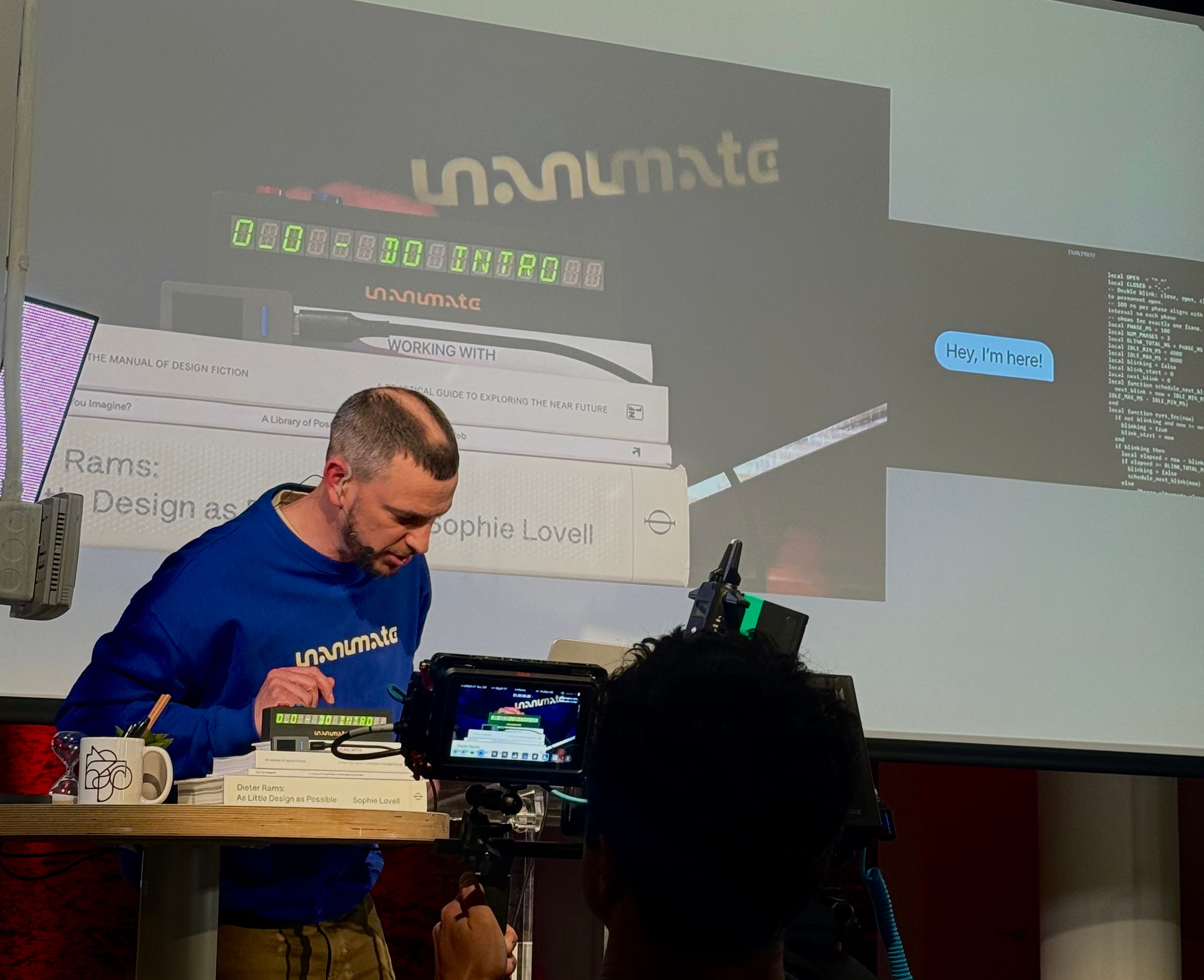
Inanimate is betting on a “new wave” era of hardware. These are AI‑native devices that look like everyday objects, are deeply personalized, customizable in real time, and responsive to all kinds of human input (especially from people who don’t think of themselves as technical). Think “robots that don’t move” and room‑scale objects, such as lamps, displays, little ambient widgets that act as endpoints for agents and turn a space into something you can literally walk into, collaborate with, and then walk away from.
The example we saw was a small desk lamp with a screen. On its face, it’s just a light, but with voice commands, it can turn into whatever you need in that moment — a Tamagotchi‑style game your kids can play with while you’re finishing emails, an interactive Pomodoro timer, a glanceable dashboard for your calendar or tasks. The point wasn’t “look at this one gadget,” but that the same physical object can shapeshift between roles on demand, with the agent underneath listening, reconfiguring the interface, and routing data, all while you just talk to the lamp.
Big Themes
I think that if you happened to have a transcript of all the pitches, the most commonly recurring words and phrases would be “knowledge graph” and terms like “personalized,” “adaptive,” and “customizable.”
On the “knowledge graph” side, this felt like the default mental model for how to make agents useful — point them at a big, messy graph of entities and relationships, and let them reason over that. It’s the obvious place for agents to shine, and you could see that in Capsule, Pai, and even PillPilot, all of which are basically saying “your domain already has a graph structure baked into it, we’re just finally making it explicit and queryable.”
The “personalized/adaptive/customizable” thread was more interesting to me. It feels as though we are beginning a new age of how to think about software as something that can be customized and reshaped around every user in real time. My working theory on what caused this is people enjoying when an LLM or chatbot “remembers” things about them. So, naturally, teams like Sky Valley and Inanimate are trying to drag that chatbot‑style familiarity and memory into the rest of software, so the app, or even the room you’re in, knows you and adjusts to your preferences.
What I am left wondering
One question I’ve been chewing on is what kinds of work should never be fully turned into an agent system, even if we technically can. There are obvious candidates in healthcare and finance where you want a human in the loop for safety or regulation reasons, but there are also more subtle categories, such as relationship‑building, taste‑making (sorry for the buzzword, I know we are kind of sick of the whole “taste” in Silicon Valley convo, but there is merit), etc. My hunch is that the most compelling products will draw explicit lines about where the agent stops and a person must make the call. There will probably also be many failures along the way.
I’m also curious about how this lands with normal people who do not care about “agents” as a concept at all (and are actually probably averse to them, a la ex-machina or The Entity from the latest Mission Impossible movie). Products like Sky Valley and Inanimate assume a consumer world where your software, or even your physical environment, is adapting to you in real time. That sounds somewhat cool to me (aside from the privacy concerns), but there are real questions around legibility/trust and time horizon. I don’t know many non-techy people who would be willing to let software rewire itself around them. I also don’t know how much control they’ll expect, and how long it will take before that transition feels obvious instead of futuristic and perhaps unsettling.
Closing Notes
I adore demo days. My first one was Techstars last winter, and hopefully there are many more in my future. I’ve written about this before, but I really do think it’s exciting to watch people pitch and build technology that sits right on the frontier of what’s possible. If you happen to be in a city like NYC, SF, or Boston, these things are happening far more often than you’d expect and they are so fun to go to!
Oh, and yes, the title is a Sontag reference :)