
The SaaSpocalypse & The Return of Hard Things
The SaaSpocalypse might actually be very good for everyone (including software)
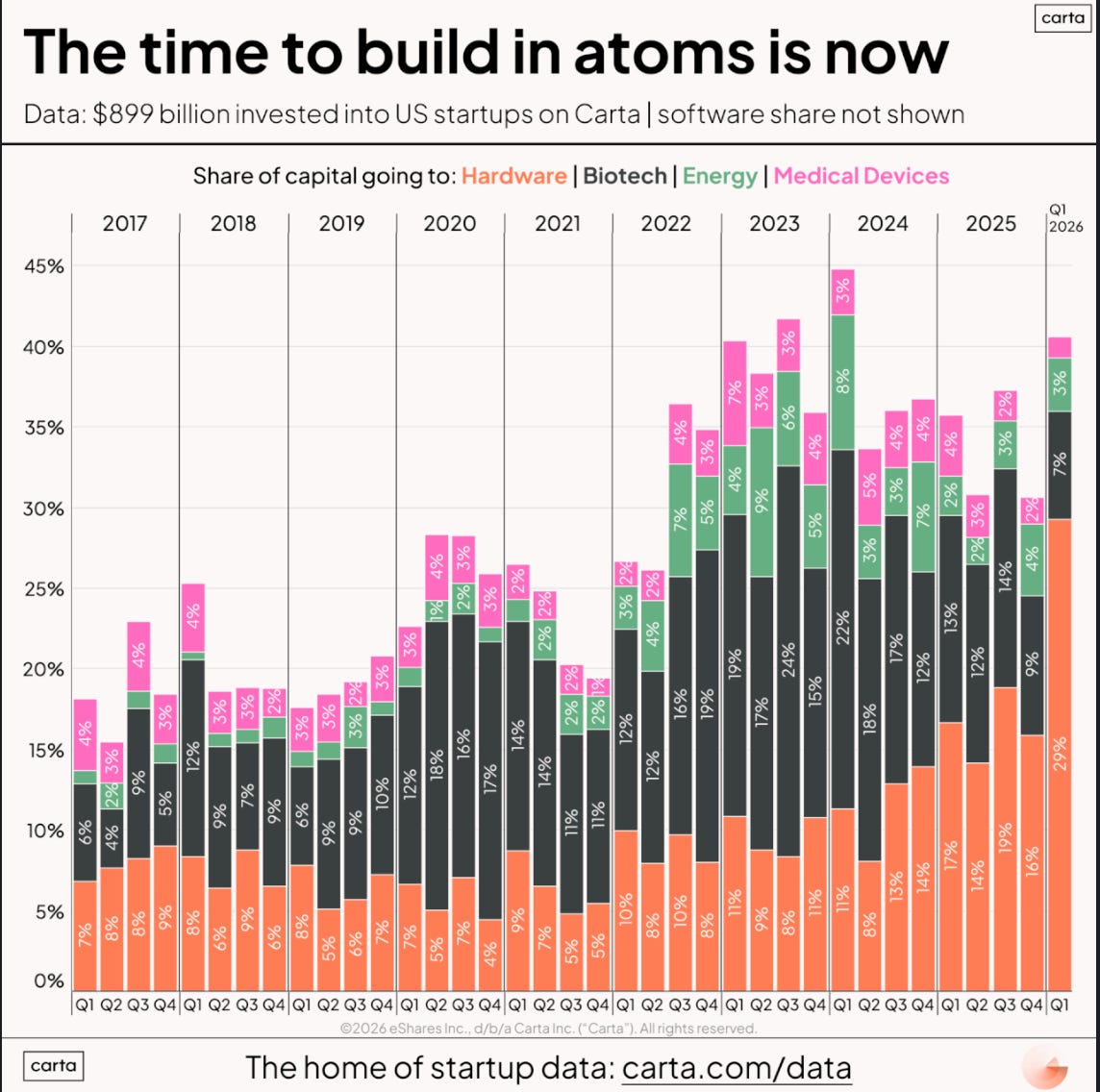
Quick aside — I was so very delighted to see this post (which also where I got the chart above) from the magnificent Peter Walker (highly recommend a follow), which is a pretty great validation of what I argue below ;)
On the So‑Called SaaSpocalypse
Depending on which corner of the internet you exist in, you probably heard about how in late February, a 48‑hour sell‑off wiped hundreds of billions off public software valuations.
The overly-simplified explanation for this selling-spree was that investors suddenly realized that if one AI agent can do the work of ten humans, maybe you don’t need fifty Salesforce licenses anymore. The articles that followed the events in the market explained that this was “the day AI started doing the work,” and that per‑seat pricing (which is essentially the crown jewel of SaaS economics) had finally met its match.
In parallel, Anthropic and OpenAI rolled out their “virtual colleagues,” demoing agents that could file tickets, update CRMs, draft emails, and generally behave like the world’s most compliant junior employee. Not surprisingly, this narrative hardened quickly online (big SaaS is dead, incumbents are doomed, and we are about to replace all of Salesforce with a couple of cleverly wired prompts).
The incumbents, for obvious reasons, do not love this story. Marc Benioff went on what can only be described as a charm offensive, insisting that this wasn’t Salesforce’s “first SaaSpocalypse,” comparing it to the shift from on‑prem to cloud and positioning Salesforce as an “operating system for AI agents,” not collateral damage. Salesforce even rolled out its own “agentic work units” pricing concept, (which seems like a spiritual successor to the per‑seat license?) to try to push the idea that software can be a sort of collaborator instead of a static tool.
Underneath the PR, though, the anxiety is certainly real. Analysts have pointed out two particularly compelling concerns for why classic seat‑based SaaS might not survive:
- Customers can replace human users with AI agents and slash license counts (this is less cool to me).
- Customers can build internal tools on top of models like Claude and Frontier that bypass traditional apps entirely (this is MORE cool to me).
It is so boring to not take a position on something, so here is mine — yes, something real is happening, but I don’t think the headline should “software is over.” Instead, I think it’s more like “cheap software finally frees capital to fund hard things.” Or in other words, we will begin to recycle a decade of marginal SaaS dollars into hard‑tech risk.
Software really has become indecently easy to spin up
TechCrunch’s post‑mortem on the sell‑off points out that AI‑native startups can “adapt, adopt, and build technology much faster than a traditional SaaS company,” and that customers who don’t like their vendor’s prices can now threaten to build an alternative. And this, to a certain extent, is true. Autonomous coding tools like Claude Code and OpenAI’s agents have dramatically lowered the barrier to writing and maintaining production‑grade code.
The result is a Cambrian explosion of what you might call vibecoded SaaS — think two‑person teams (or one person plus a high pain tolerance) who use AI to scaffold a whole product stack in weeks or internal teams who throw together custom tools that fit their workflows better than whatever generic SaaS they were using before. The irony, of course, is that a lot of this vibecoded, in‑house software isn’t actually validates what people really want and felt like they were missing from their current provider. Hopefully some of those internal tools will eventually harden into the next wave of durable SaaS products once they escape the four walls of a single company.
Here is where my observations get a little more interesting. Early-stage investors are noticing this “ease of building” phenomenon. And several analyses point to a sharp bifurcation: a handful of AI‑native or infrastructure software names still command rich multiples, while the long tail of traditional SaaS names trade down and struggle to raise. Carta has documented that software rounds are smaller, more selective, and heavily skewed toward companies that either have real traction or are embedded deep in the AI stack.
Basically, if you are trying to pitch “Salesforce, but with agents,” you are now competing with every in‑house engineer who has ever opened a prompt window… sorry.
What Early-Stage Money Was Actually Paying For
Under the old regime, early SaaS money, especially at pre‑seed and seed, did three jobs at once:
- Pay for a team to build the first version of the product.
- Pay for GTM experiments to find someone who cared.
- Pay for everyone’s rent and burn while (1) and (2) took longer than expected.
Now, agents can do a non‑trivial chunk of (1) and a surprisingly large chunk of (2). That doesn’t make founding a necessarily company easy, but it does make shipping a decent v1 and testing channels dramatically cheaper.
Public‑market panic tends to obscure this, but it’s worth pointing out that in retrospect, a lot of pre‑seed/seed SaaS rounds were always over‑capitalized relative to what they were really doing. The “we need $5M to find out if someone wants this workflow solved” era only made sense when every experiment demanded a full human team. If two people and a fleet of AI coworkers can reach the same learning milestones on a tenth of the money, the pre‑seed/seed check for pure software does not look like a necessity, and investors are already treating it that way.
It would be stupid of me not to point out that there is also something mutual about this unwinding of early-stage capital being invested in SaaS. If AI and better tooling mean it no longer takes a full-stack village to get a product to $1–2M in ARR, then early-stage founders don’t actually need the same kind of VC support they used to… and that’s good for them!!!
Carta’s latest numbers show median dilution ticking down across seed and Series A as capital-efficient, often AI-native teams raise less frequently and at higher valuations. In practice, that means more founders can choose to skip or shrink the classic “venture-backed seed” and hold onto a much larger share of their company while they let agents and a tiny core team do the heavy lifting.
The punchline, though, isn’t “no more investors,” it’s “investors later.” If the SaaSpocalypse really does flush out the overfunded tools, what you’re left with is a smaller cohort of durable, mission‑critical SaaS companies that are still growing. Growth investors and PE are already quietly circling those: 2025 was a record year for SaaS M&A, with private equity involved in nearly 60% of deals, and the upper quartile of SaaS names in one major index still put up positive returns while the median sagged.
Fast‑forward a few years and you can easily imagine a world where the real action in software is not at the frothy pre‑seed table, but in chunky growth rounds and buyouts for the survivors of the SaaSpocalypse, which, for anyone who still loves software (me!!!), makes the growth side of the stack look particularly exciting.
The Return of Hard, Capital-Intensive Things
If you look at where new funds and “hot theses” are clustering, you will see a pattern of concentration across climate, energy, robotics, new materials, AI hardware, and biotech platforms. Essentially, the stuff that can’t be spun up with the help of Codex in a weekend, no matter how good your prompts are.
Climate and energy are a good example. Recent climate tech reports show tens of billions flowing into grid infrastructure, storage, industrial decarbonization, and “hard” energy projects. These are exactly the kinds of companies that need massive upfront capex for pilots, plants, and physical assets, face multi‑year regulatory and engineering risk, and can’t be bootstrapped with $10k and a Notion page.
Back to the SaaSpocalypse for a sec — if AI has truly exposed how much of the SaaS sector was marketing spend wrapped around interchangeable code, it has also highlighted the kind of software that actually deserves to exist — products that own a critical workflow end‑to‑end, tackle messy regulatory/domain complexity (Delve for instance, would be a company that did NOT do this), sit on top of irreplaceable data exhaust, or feel more like infrastructure.
What Survives (And Why This Is Net-Positive)
None of this means SaaS disappears. In fact, for the best SaaS companies, I would argue that this moment is actually a gift. If you are mission‑critical and already live in the center of your customers’ workflows, agents make you more important, not less, and you get to be the orchestration layer that routes work between humans, systems, and AI coworkers. Your data exhaust becomes an even deeper moat as models fine‑tune around it, your embedment in existing processes makes you the default place to plug agents in, and your pricing can evolve from static seats to usage‑based and “agentic” units/tokens that more closely track value created. In that world, the winners increase product surface area and become the operating systems that everyone else builds on top of.
However, the days when “we are a horizontal SaaS tool for knowledge workers” automatically translated into an over‑subscribed seed round are probably gone. Thin, copy‑and‑paste SaaS will get commoditized, whereas thick, infrastructure‑like platforms and deeply embedded systems survive. The market is already sorting that out with a level of brutality only public tickers can deliver.
Another upside of this reaping is that founders working on hard, capital‑intensive problems may finally get something like a fair shot. For years, these teams have been the underdogs — higher technical risk, slower timelines, and a fundraising environment biased toward the quick, clean story of “SaaS but for X.” Now, as cheap vibecoded software crowds that narrative, early‑stage capital is forced to look elsewhere.
If we’re going to have a market panic, I’d rather it be the one that ends with more geothermal projects, robots in factories, climate hardware, and serious biotech platforms getting funded. And for those of us who still love software, that also sets up some of the most interesting growth‑equity vintages we’ve seen in a decade in the form of fewer, better SaaS names sitting next to a new class of hard‑tech compounders. Or perhaps some combination of the two… the software + IoT model will always be a personal favorite.