
Veronica's 2026 Mid-Year Outlook

James Barry, Crowning the Victors at Olympia (from “The Progress of Human Culture”)
To state the obvious, it is not the middle of the year. I guess the more apt title for this would be “Veronica’s 2026 2/3 Outlook”, but that doesn’t sound great. Anyway – in the spirit of the bulge bracket bank, I will be presenting you with a running list of what’s occupying my attention this summer (please note, this is not a predictions post), dominated by one overarching theme:
Oh my, we are soooooo early in this AI buildout. And oh my, there is sooooo much I think we are doing wrong, and, more optimistically, there is oh so much opportunity!
To those closest to my age bracket, AI maybe does not feel very early (we had ChatGPT since our junior year of high school), but it is! That makes the world of technology that you and I exist in exciting for many reasons, but the one most relevant to what I write below is the fact that the categories built on top of these innovations are nowhere close to being won. Many of the people who agree with me on the latter point will bring up MySpace or Netscape as examples of what many deemed category-winners at their peak – but look where we (and those companies) are now. There are endless examples of early-leaders in waves of new technology who are now nothing but a HBS case study about what went wrong. And we know that technology today is moving faster than it ever did. Welcome to the precipice.
First, a note on private markets
You may or may not be aware that I have spent much of my summer at J.P. Morgan on their Asset & Wealth Management Platform, which manages around $4.8 trillion in total assets. It is a wonderful place with many smart people who have been generous enough to spend their (very) busy time with me. This summer has been, above all, an education in how private markets look from the outside, from the vantage point of those who invest in private companies without building them (or better put, in a different way that I am used to seeing private markets). J.P. Morgan is the biggest bank in the world, and it does a staggering number of things well beyond private investing. It manages an enormous amount of other people's money across countless platforms and products, and while it certainly invests in private companies, it sits a good deal farther from the venture world than the firms I usually find myself around. So here is an institution with no specific mandate that forces them to care about private markets, and yet, let me tell you, they are excited. Which was great for me, because not only did this confirm my interest in private markets, but it gave me the data to rationalize and then articulate why I find this space so compelling. So here are a few exciting takeaways of mine:
- Companies are staying private longer AND 2026 has been one of the strongest IPO/M&A windows in years. The median age of a company at IPO is around 12 years (among the oldest cohorts since 2009) even as global private capital AUM has ballooned from under $1 trillion in 2000 to $16 trillion by 2024.
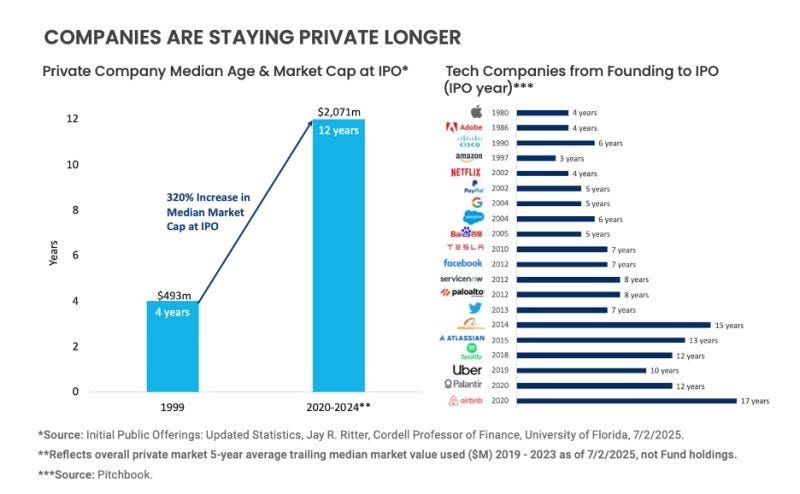
The reason for this, it seems, is that companies simply don’t need to go public for capital access anymore. And yet upwards of $3 trillion in combined value could IPO this year alone, with centicorns like SpaceX, OpenAI, ByteDance, Anthropic, Databricks, and Stripe all on the list. I came to the understanding that both things are true at once – private markets have gotten deep and liquid enough that going public is now a choice, which paradoxically makes the IPOs that do happen more significant.
- On valuations of these private companies, the data is contradictory. Which is interesting.
A Q1 SaaS M&A report from Windsor Drake found that public markets still trade at roughly a 35% premium to private deals. But Goldman’s late-2025 private markets outlook found that gap had narrowed to near the long-term average. And KingsCrowd’s read on equity crowdfunding data found the opposite in some sectors — private multiples in green energy, education, and financial services vastly exceeding public comps.
My read here is that none of these are necessarily wrong, but they are measuring different markets. Late-stage SaaS buyouts and crowdfunded venture rounds are not the same asset class, and perhaps the current valuation-parity narrative glosses over that.
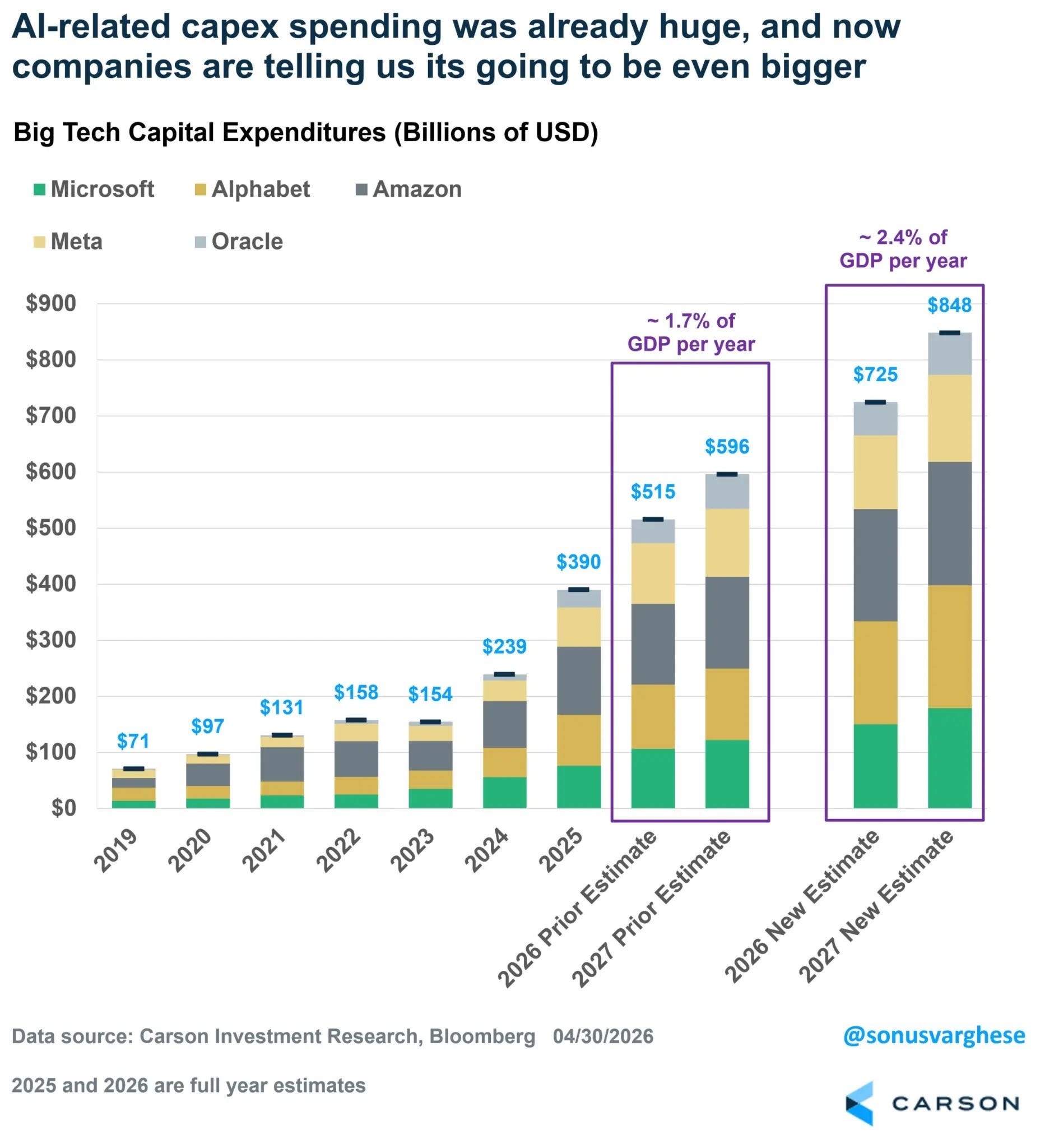
Conversely/of note – what is not ambiguous is where capital is going. AI infrastructure and buildout pulled in an estimated $47 billion in private capital in 2025, and 2026 is on pace to exceed it. Goldman’s hyperscaler capex consensus for 2026 has climbed to $527 billion, up from $465 billion at the start of Q3 2025 earnings season. JPM’s own mid-year outlook named AI capex the dominant growth driver for the back half of this year.
- The last piece of my private market conviction comes from fixed income (oh yes, I know enough about that to actually have an opinion on it now ;D). Equities and bonds were long assumed to be negatively correlated, and that relationship was certainly taught to me, but recently, that assumption has been under strain. Some parties expect the correlation to swing positive again in 2026 as term premia and fiscal activism reassert their influence, which would be bad news for traditional 60/40 diversification. Others take the opposite view, arguing correlations are reverting slightly negative as inflation moderates.
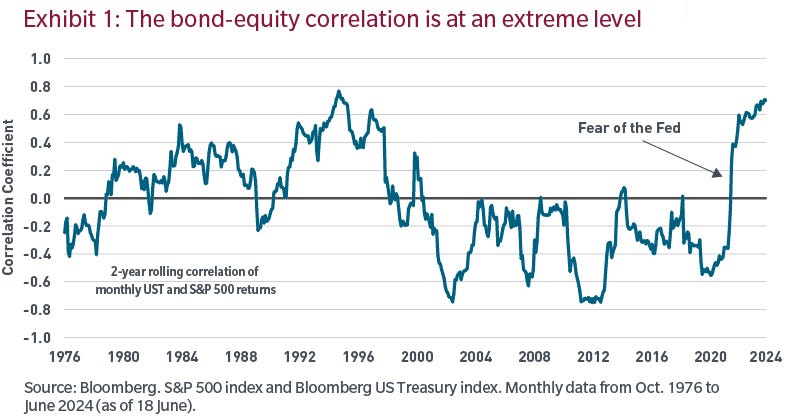
I am not entirely sure which take is correct here, and I am not in the business of making predictions on this facet of finance in particular, but I mention it because the very fact that the disagreement exists is, I think, part of the reason why institutional capital is looking toward alternatives.
Now on the themes I am currently tracking and will continue to.
Theme 1: Cybersecurity
The founders of Neo will tell you that cybersecurity was built on the assumption that software behaves predictably, and moreover, that assumption breaks the moment AI agents start inheriting user identities and acting autonomously on their own initiative. Given that they came out of stealth two days ago with $100 million in cumulative funding, I am inclined to believe them.
In all seriousness, Neo’s recent raise is certainly indicative of the excitement (or, given the nature of the sector they are building in… I might even call it the desperation) for better cybersecurity technology. And I can tell you, having spent weeks inside a large institution with incredibly sensitive data – that desperation surfaces in every conversation about the most prevalent risks facing the firm. If you asked the CEOs of many of these large and important institutions what keeps them up at night/what they worry about (which, in our summer analyst training, someone actually did) they won’t mention rate moves or regulatory change – they will say cyber threats, full stop.
If you accept the premise that firms that have spent a decade hardening their perimeter against human-scale attackers are now being asked to secure a workforce of autonomous agents that act faster than any compliance team can review, then you would be excited about Neo’s raise as well, as this is the vulnerability window they are underwriting.
So I have cybersecurity on my mind. And I think that it’s imperative, whether you’re in the business of making money, building great companies, or ensuring the protection of your client’s most sensitive data, that you work to scale control layers at the same pace as the intelligence layer they guard. More clearly put, if frontier AI is this decade’s offense, cybersecurity for agentic systems is shaping up to be the decade’s most necessary defense. Onwards!
Theme 2: The Neolab Ecosystem
You may have stumbled across the piece I published recently on the philosophical debate at the heart of many of these labs (see map below).
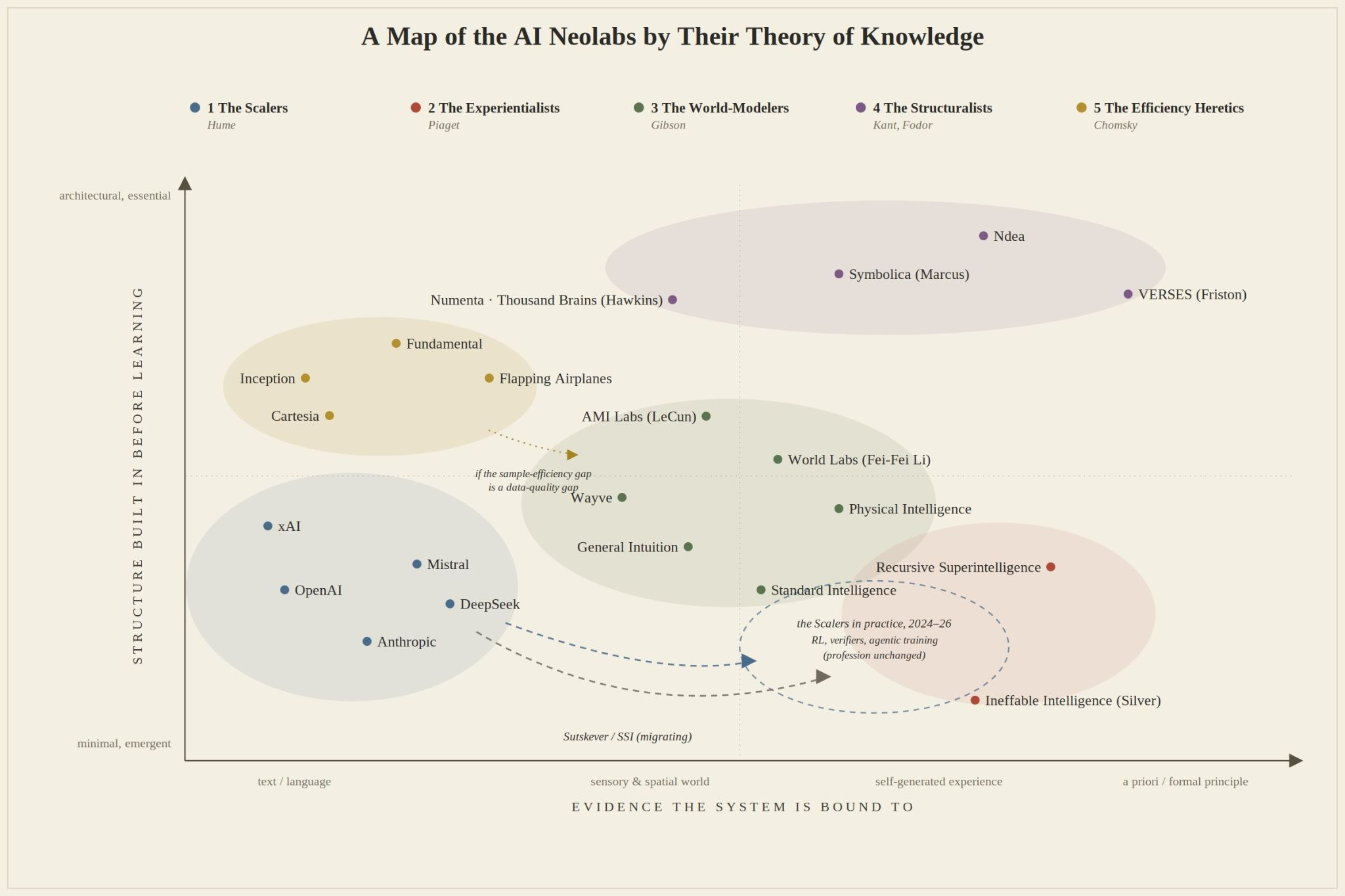
If not, no worries. Here are some highlights.
The empiricist wing of this debate is most visible in world models, and of all the neolab categories I mapped, this is the one I am most excited about. World Labs has raised $1 billion total, including a $200 million Autodesk strategic check in February at a $5 billion valuation, and its Marble product has been generating persistent 3D environments since November.
Its rival, AMI Labs, closed a $1.03 billion seed in March at a $3.5 billion pre-money valuation, backed by an eclectic group including Bezos Expeditions, Eric Schmidt, Mark Cuban, and Tim Berners-Lee, with a JEPA-based energy model running from raw pixels on a single GPU.
Another company of great interest to me (and NYC based, YAY) is General Intuition. Spun out of Medal, they are building action models and world models that are trained on billions of gameplay clips. Simply put, they fit my core conviction that compute will eventually stop being the bottleneck (shoutout AMC PBC), and proprietary data will become it. General Intuition is, in effect, a bet that a training ground no one else has (an enormous, action-labeled record of people playing) is the substrate a world model needs to learn how reality behaves.
Others share that broader instinct about data, which is why you can find them either 1) buying obscure book libraries for text no one else has touched, or 2) developing models that are incredibly data efficient.
Theme 3: Frontier Drug Development and Thin Evidence Bases
On the note about scarce data – after my own brain tumor surgery, I got a very visceral education in how thin the evidence base still is behind even routine medical decisions. This is part of why I started Whel, and part of why the Boston Tech Week events that I attended were overwhelmingly biotech focused (of course, it was also Boston so what do you expect).
Isomorphic Labs, Alphabet’s drug-design spinout, announced a $2.1 billion Series B in May, led by Thrive Capital with Alphabet, GV, and new investors MGX, Temasek, CapitalG, and the UK Sovereign AI Fund all participating. Its Drug Design Engine, IsoDDE, is reported to outperform AlphaFold3 on structure prediction, binding affinity, and novel candidate generation across small molecules, biologics, and antibodies, and the company has partnerships with Novartis, Lilly, and J&J. What to make of this all? I tend to agree with those who take this raise as proof that capital is still available for AI drug discovery even as biotech funding broadly has tightened.
For a clear articulation of where this is all headed, I would point you to a recent MS&E 435 conversation between Joshua Meier of Chai Discovery and Eric Kauderer-Abrams of Anthropic on AI applied to biology. The core idea is to stop discovering drugs through trial and error in the lab and start designing them on a computer, the way you would design a car or a chip. A new drug today takes 10 to 15 years to develop, and they make the case for getting that under five. The step after that is wilder still, giving AI its own hands in the lab, wiring it straight to the machines so it can run real experiments and design a medicine start to finish. The talk is quite interesting. I suggest a listen. When asked to name the next blockbuster, their answers were a drug that makes you ripped and a drug that makes you sleep, which, given the increasing rate at which people seem to be using off-label Chinese peptides, seems plausible...
Theme 4: The 24/7 Agentic Workforce and SaaS Disruptors (SoRs vs. SoAs)
This is what much of my work at NEA this past spring was focused on. It might be helpful for you to think of this theme as two, tightly connected threads – a 24/7 agentic workforce, where agents handle finance, HR, and IT operations so human teams can focus on higher-leverage work, and, more broadly, a shift in SaaS from static systems of record (SoRs) to intelligent systems of action (SoAs).
While at NEA, I did a lot due diligence on companies in this space, contributing to two investments — Centralize, an AI-driven sales relationship-intelligence platform at its Series A, and Sol, an agentic core HR system built to replace a traditional HRIS outright, at its Seed (it had just come out of stealth).
I remain incredibly excited about this sector, and I think the thesis I developed – that incumbents like Salesforce, Workday, and NetSuite will hold the data and compliance moat as systems of record, while new agentic spinups fight for the action layer that determines who owns the customer relationship and the budget – is the right one.
Microsoft, AWS, and Google are all converging on the same pattern in their own stacks. And lucky for me and my personal interests, funding follows – agentic AI venture funding hit $658 million across 18 deals in Q1 2026, nearly triple Q4 2025. Straiker’s $64 million Series A at the end of June, explicitly to secure the agentic workforce, is a useful companion to Neo from Theme 1.
Also, you should know that the day Epic Systems is uprooted and ripped out (note the violent imagery) will be one of the happiest days of my life.
Theme 5: European Defense
Back to the public markets. Most of the defense discourse I read is America-centric, which, while it makes sense, is perhaps a mistake/oversight. NATO’s Hague commitment has allies moving toward 5% of GDP on defense by 2035, and in 2025 European Allies and Canada increased defense expenditure by nearly 20% year-over-year. This is not NATO’s first attempt at fixing the imbalance – the 2% guideline dates back to 2014, agreed at the Wales Summit in direct response to Russia’s annexation of Crimea.
But for most of the decade that followed, only a handful of members ever hit it, which is perhaps one reason why the “America-centric” framing of defense discourse took hold in the first place – the US ended up carrying a lopsided share of the alliance’s total spending for years, even as its own relative share was shrinking.
What’s different now, though, is the speed at which the allies are catching up/investing in defense – Europe is compressing into a couple of years the kind of reinvestment that took most of the post-Wales decade to show up. And ahead of the Ankara summit, Reuters reported five NATO members already on track to hit the 3.5% core-defense target in 2026.
There is a very clear takeaway from this – NATO allies are underwriting less of their own defense than the US used to expect, and that gap, after a decade of missed targets, is being closed with lots of reinvestment.
The equities I am interested in that align with this view are BAE Systems, Safran, and IHI. BAE was up 23% year-to-date as of mid-February, with revenue up 8%, operating profit up 9%, an order book £2.7 billion larger than in 2024, and a 10% dividend increase. And it backed its 2026 guidance in May citing higher defense spending opportunities.
Across the sector, 2025 returns were dramatic: Rheinmetall up 190%, Huntington Ingalls up 85%, BAE up 64%. Though, I will flag that some of the sector’s moves are definitely geopolitical-shock-driven as well – European and Asian defense stocks all rallied 2-5% on the March US-Iran flare-up alone, and a few analysts have started warning that valuations may already be pricing in fairly optimistic growth assumptions. I still think the structural case (underspending allies, rising baseline commitments) outweighs the event-driven effects, but it is worth a quick acknowledgement.
Theme 6: Vertical Software for Under-Digitized Industries
I remain, as I did ten months ago, incredibly bullish on vertical software for under-digitized and legacy industries, particularly manufacturing and industrials. These industries are still running on decades-old tooling, and many compounding factors, such as the silver tsunami and labor shortage, make this an attractive market to invest in. Not every investment needs to be as sexy as neolabs. Under-digitized doesn’t (and shouldn’t) mean under-appreciated.
Of recent interest to me in this space are startups pursuing a combination of software and hardware for these legacy industries, such as an AI-native OS that pulls and acts upon proprietary data from IoT monitoring systems. This builds the ever-necessary moat/proprietary data that makes companies all the most sticky and durable.
Theme 7: Token Economics
We are beyond the era of Tokenmaxxing. Thank God. That was a mistake. I also think we are beyond the era of just “here is how many tokens you are burning” though, because what does that actually tell us? It doesn’t necessarily quantify the value of a token (which is abstract) or tell us what we SHOULD be spending. So what we are well into, I think, is the era of “here’s your return on those tokens,” because companies (and in particular CIOs & CFOs facing a lot of questions from their boards) are desperate for a tool that can price that shift into how they consider the AI capex buildout. For anyone who wants the fullest version of this argument, please see Return on Tokens (ROT) by the ever-brilliant Markie Wagner.
Something particularly interesting within this thematic interest of mine is the Jevons Paradox that is playing out – while token prices have fallen more than 90% since 2023, LLM spending has doubled since late 2025, because cheaper tokens means unlocking more workflows. Unfortunately for much of corporate America, Agentic AI multiplies this further, as these tasks consume roughly 1,000x more tokens than equivalent chat interactions, with up to 30x variance in cost for the exact same workflow run twice. And let’s just be honest, employees do not need to run an agent for a glorified Google search. So the ROT is not there.
How I have come to understand this space is in four layers: LLM gateways (usage telemetry), LLM observability (quality and latency), cloud/AI FinOps (cost allocation), and, at the top, AI unit economics (business value/was it actually worth it?).
The dedicated players building that top layer have raised roughly $50 million combined, against the roughly $150 million that Arize alone has raised in the adjacent observability layer. The open question for this whole category is whether it survives as a standalone product or gets absorbed as a feature by the bigger observability and FinOps platforms sitting right below it, which is the pattern that played out with AIOps and synthetic monitoring in the last cycle. My take? See the introduction to this piece – nothing is won yet. I am excited to see this category play out over the next 12-24 months.
Lastly, I do have interests/a life outside of what I wrote about above. Some things I have enjoyed recently are:
Nolan’s Odyssey, a Lord of the Rings rewatch and reread (still the best book to movie adaptation of all time), Ross Douthat’s Interesting Times podcast for the NYT, LCD Soundsystem, Pinkberry’s original tart flavor, and the fried artichoke appetizer at I Sodi in the West Village (see below).

Thanks as always.